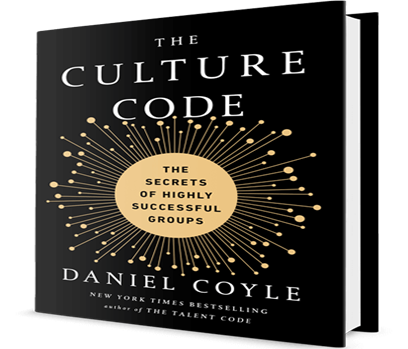
Book Review: The Culture Code by Daniel Coyle
1 Introduction
The Culture Code by Daniel Coyle offers a deep examination of how successful groups build strong cultures that promote trust, cohesion, and high performance. I chose to read this book because of my personal interest in leadership, group behaviour, and organisational culture. Between August and December 2025, I completed the book three times, each reading providing deeper clarity.
Culture is not abstract; it is lived behaviour. The term comes from the Latin cultus, meaning “core,” reflecting the idea that culture forms the core identity of any group. Coyle also discusses the Allen Curve, which demonstrates how physical proximity affects communication: when distance exceeds eight (8) metres, communication drops sharply. This insight is practical when designing office layouts, meeting arrangements, and teamwork spaces.
Coyle also poses fundamental questions that shape group culture:
-
Are we connected?
Do we share a future?
Are we safe?
When groups build safety, share vulnerability, and establish purpose, they shift from individualistic behaviour to interdependence—allowing members to work as one unit. Group culture remains one of the powerful forces we have in our communities, workplaces, families, churches, corporate world. We can know whether the group is functioning or not by the state of its members.
2 Summary of the Book
Coyle identifies three essential skills that define strong group cultures.
I). Building Safety
Safety is created through belonging cues—small behaviours that signal connection, respect, and shared identity. When members feel safe, they naturally collaborate and prioritise group success. Coyle notes that there is no place for pure altruism; groups succeed when members understand that everyone’s performance is interconnected.
Key behaviours that build safety:
• Warm, attentive communication
• Clear acknowledgment of contributions
• Predictable, consistent interactions
• Removing unnecessary status barriers (e.g., calling superiors by nicknames to reduce tension and encourage openness)
II) Sharing Vulnerability
Coyle argues that vulnerability does not follow trust—it precedes it. Groups become strong when members openly share weaknesses and uncertainties. The example of the Navy SEALs (Chapter 10) illustrates how shared vulnerability created elite performance, including the operation to capture Osama bin Laden. Their success emerged from candid communication, mutual dependence, and the courage to challenge each other.
Key insights include:
• Vulnerability sparks cooperation.
• Humans instinctively hide weakness, but high-performing groups normalise it.
• Real courage is “seeing the truth and speaking the truth.”
• Safe environments are required for people to challenge authority, avoid blind obedience, and contribute ideas.
Coyle highlights authority bias (authority heuristic), where a superior tells you to do something, and you tend to follow or do it, even when they are wrong. How do we develop ways to challenge each other, ask the right questions, encourage interaction, build trust, and never defer authority? Strong cultures intentionally reduce this bias by creating environments where questioning is encouraged and asking the right questions. A group has to create conditions/environment where they start doing it. Start with a small safe space for safe talk to interact with.
III) Establishing Purpose
Purpose gives direction, meaning, and clarity. High-purpose groups use vivid, repeated signals to show:
Here is where we are,
and here is where we want to go.
Purpose connects identity to action and aligns teams toward long-term goals.
Key ideas include:
• Mental contrasting—linking future goals to present realities.
• Using stories and shared language to shape behaviour.
• Recognising that groups require different leadership styles depending on whether their work demands proficiency (consistency, reliability) or creativity (innovation, exploration).
Proficiency-focused leadership includes:
• Clear models of excellence
• Rules of thumb
• Consistent routines
• Feedback-driven practice
Creativity-focused leadership includes:
• Providing support, tools, and protection
• Encouraging experimentation
• Leading without over-directing
• Helping teams build something new
Coyle emphasises that most organisations require a blend of both.
3 Key Lessons Learned
• Psychological safety is the foundation of performance.
• Vulnerability must be modelled by leaders first.
• Belonging cues—small signals—shape behaviour more than major announcements.
• Purpose must be communicated clearly, frequently, and concretely.
• Groups require different leadership styles for proficiency vs creativity.
• High-performing cultures measure what matters.
• Stories, repeated signals, and shared language reinforce culture.
Additional actionable insights from the book:
• Leaders and their team members should ask these three key questions, creating an avenue for open conversation horizontally:
1. What is one thing I do that you want me to continue?
2. What is one thing I should do more often?
3. What can I do to make you more effective?
• Overcommunicate expectations
• Embrace discomfort
• Separate performance reviews from development discussions
• Encourage flash mentoring—short, targeted peer learning that strengthens relationships
• Listen “like a trampoline”—engage with curiosity and energy
Nyquist Method
Coyle highlights the value of leaders being warm, curious, and encouraging continual learning. This is similar to the idea of being a “lifelong student,” always asking questions and demonstrating genuine interest in the people you lead or to other team members in a group.
4 Relevance to My Work
The principles in The Culture Code align closely with the challenges and opportunities within team-based environments. Building safety supports open communication, which is vital in operational, commercial, and administrative work. Sharing vulnerability encourages teams to raise issues early, analyse problems honestly, and support each other. Establishing purpose helps unify teams around organisational priorities, clarifying expectations and strengthening accountability.
These insights can enhance team coordination, leadership effectiveness, and organisational culture in any setting.
5 Final Verdict / Recommendation
The Culture Code is a powerful guide to understanding and shaping group culture. It combines research, storytelling, and practical tools that can be applied in both professional and personal environments. I highly recommend it to leaders, managers, and team members seeking to improve trust, collaboration, and purpose within their organisations, families, communities, churches, etc.

Comments are closed